






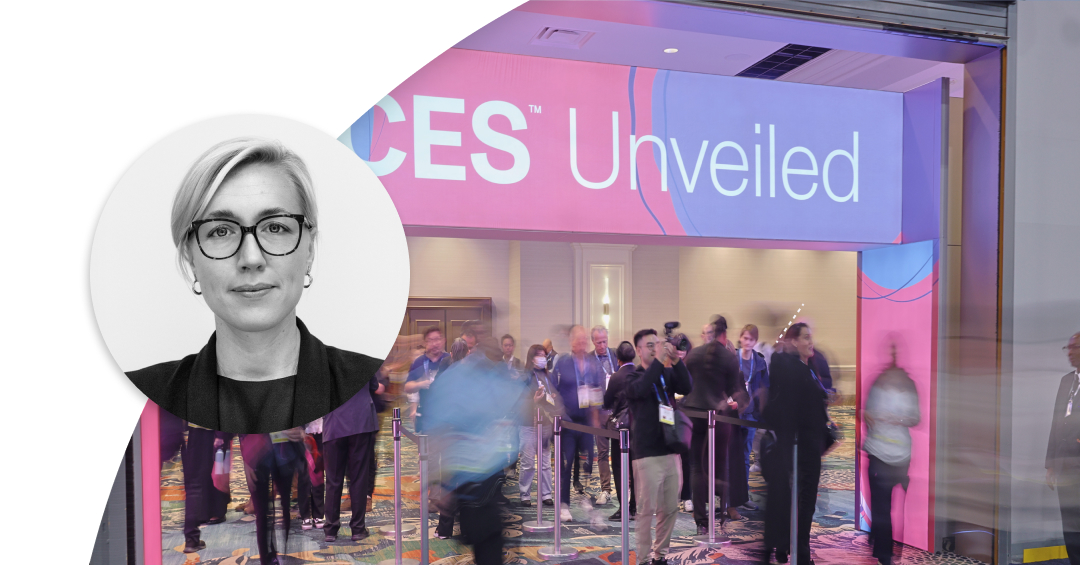
Image credit to Consumer Technology Association (CTA)®
CES 2026 made one thing very clear: AI is no longer an emerging trend within mobility; it is the foundation. From software-defined vehicles to immersive in-cab environments, mobility innovation is accelerating at an unprecedented pace.
Amid all the buzz and excitement, one theme stood out clearly for us: as vehicles become more intelligent, understanding the driver becomes even more essential to realizing the full potential of these innovations.
As providers of predictive AI focused on driver behavior, CES served not only as a glimpse into the future, but as confirmation that the next phase of mobility innovation will be defined by how effectively technology adapts to the driver; supporting safer, smarter decisions as the ecosystem evolves. Here’s our round-up of this year’s event.
Described as “the world’s most powerful tech event”, CES lived up to its reputation. This year, the event attracted over 148,000 attendees, more than half of them senior-level executives, with over 4,100 exhibitors.
Mobility innovation has become one of the biggest focuses of CES, with automakers, tech companies, and solution providers coming together to shape the future of transportation.
Yet from our perspective, it’s not only the technologies unveiled at CES that are important – even more so is considering how the role of the driver is evolving as these technologies move from concept to everyday life.
One of the standout innovations came from our partner Smart Eye, together with Alps Alpine and AUO Mobility Solutions. Their “invisible” driver monitoring camera – embedded behind the instrument cluster display – showed how safety technology can be integrated without compromising vehicle design or distracting the driver.
Siemens’ unveiling of the Digital Twin Composer also drew attention. The ability to build and operate virtual environments where products and processes can be tested before entering the real world promises faster development, lower costs, and sustainability benefits. I’d be particularly interested to see whether it would be possible to replicate driving environments, and how human behaviors could be integrated into digital worlds.
Bosch’s AI-based cockpit was another technology that highlighted the role of AI in mobility. As well as showcasing features that enable the in-vehicle environment to be highly personalized, Bosch presented Vehicle Motion Management software that centrally controls vehicle movement and aims to prevent motion sickness. While Bosch describes this as “an important step on the way to autonomous driving”, as a sufferer myself, I’m also fascinated about whether it could reduce symptoms in the interim.
These examples share a common theme: AI is a key part of the driver experience – which makes behavioral insights even more valuable.
Proactive and predictive safety was a recurring theme throughout CES, and it was encouraging to see a keen focus on making safety technology affordable to everyone.
Sustainability conversations were closely tied to circular technology, particularly with regards to retrofitting and extending vehicle lifecycles. Of course, technology can deliver real gains when it comes to sustainable mobility, but we mustn’t forget the important role of driver behavior. It’s the way drivers interact with technology that delivers real results – so measuring and optimizing driver behavior while developing new AI in mobility technologies is when the true potential is realized.
One of the most reassuring takeaways from CES was that the driver hasn’t been forgotten. In fact, it was quite the opposite – many innovations were very driver-centric, with AI copilots looking set to become “personal assistants” for drivers.
As exciting as these developments are, they do reiterate the growing importance of understanding how drivers interact with increasingly rich in-vehicle environments. Getting the balance right will be key to success; ensuring that AI enhances focus and safety, rather than competing for attention.
AI is now the core of most innovations in mobility. But the most important consideration today is not whether AI is present, but whether it is informed by an understanding of human behavior.
AI has moved from simply answering questions and responding – to knowing people inside and out. But true personalization goes beyond comfort and convenience. It means adapting technology to how different drivers respond to their environment and anticipating risk before it causes a problem.
The most compelling solutions at CES were built through collaboration. No single company can solve the mobility challenge alone – especially when human behavior is involved.
Compared to last year, there was a noticeable difference in the overall feeling about AI in mobility. In 2025, AI still felt like a buzzword, to be approached with caution. This year it feels embedded at the heart of many mobility strategies, with far more technologies moving from prototype to practice.
There was also growing interest in health-related technologies – and this is an area where I believe driving health deserves more attention. Driving is one of the most frequent and risky activities many people perform daily, yet it remains largely absent from broader health discussions.
In his keynote, Gary Shapiro, CEO of the Consumer Technology Association, described AI as “the big picture” – while emphasizing the importance of trust and human connection. This was the perfect reminder that, as we look to the future of mobility, human factors remain central.
In another speech, Siemens CEO Dr. Roland Busch spoke about industrial AI and digital twins, noting that when the right technologies, domain expertise, and partnerships come together, organizations move from reporting issues to anticipating them.
When applied to the mobility landscape, this sums up the opportunity ahead perfectly: when AI truly understands driver behavior, crashes won’t need to be reported. Instead, they will be anticipated and avoided.
CES 2026 demonstrated that the “software-defined vehicle” isn’t a future concept; it’s today’s standard. If a vehicle isn’t built on a foundation of AI, and can’t be upgraded or personalized, it’s already old news!
What CES 2026 made clear is that the success of innovation will increasingly be measured by how well it works for the people behind the wheel. Delivering AI in mobility isn’t enough. We need to understand that people are still at the heart of mobility and ensure that technology prioritizes the safety of those people. All while helping businesses to become more efficient and productive.
The future of mobility isn’t just about smarter vehicles – it’s about smarter understanding of the drivers who use them.