







Today, mobility generates massive amounts of data. Every trip on the road produces countless GPS data points – but what hidden information can that driving data tell us?
Collecting data is no longer a challenge. Modern vehicles, devices, and platforms do that effortlessly. The real challenge is understanding what the data actually means. And, even more importantly, what it can predict.
On its own, raw GPS data is just a record of movement. But when those movements are analyzed over time and at scale, patterns emerge. It’s those behavioral patterns that allow us to move from simply describing past trips to predicting future risk, including the probability of a crash.
Here, I explain what we mean by identifying behavioral patterns in GPS data, how those patterns translate into crash probability, and why this approach represents a fundamental shift in how we understand driver safety.
At its core, GPS data is location and time. It tells us where a vehicle is, how fast it’s moving, in which direction, and when. On its own, that information is limited.
The intelligence comes from the interpretation. With AI, GPS data can be transformed into behavioral insights by analyzing how factors such as speed, direction, and movement evolve across entire trips, not just in isolated moments.
This makes it possible to understand how a vehicle is driven: how smoothly or harshly it is handled, how consistently the driver anticipates traffic flow, how the driver adapts to different driving environments, and how behavior changes over time.
Driving behavior isn’t defined by one instance of sharp braking or acceleration. It’s expressed through patterns. And it’s these behavioral patterns that matter when assessing risk.
There’s no denying that traditional telematics systems provide value. They’re widely used to track vehicles, monitor vehicle use, record driving hours, and optimize routes. They are also used to support safety efforts through the identification of “events” such as harsh braking, cornering, or speeding.
But event-based models have limitations. They look backwards, capturing snapshots rather than the full picture. They also lack context. A harsh brake could indicate risky driving, or it could be a safe response to a sudden hazard. And everything that happens between those events usually goes unseen.
Most importantly, events-based systems imply that risk is something that happens in isolated spikes. In reality, risk tends to build gradually.
Risky driving behavior is rarely random. It usually develops over time, often through slight deviations in behavior. For example, small changes in smoothness or anticipation. These changes might not be enough to trigger a traditional alert but still carry meaning when observed repeatedly.
External factors like stress, fatigue, or poor health can influence a driver’s focus and decision-making, and these influences often show up as tiny behavioral shifts long before an incident occurs.
Recognizing these changes allows us to move from answering “What happened?” to “What is likely to happen?”. This is an important move for crash prevention.
Raw GPS points don’t describe driving behavior on their own. Insight comes from temporal analysis (examining how data points relate to one another over time) and from comparing those patterns against billions of driving patterns linked to real outcomes.
This type of pattern-based approach makes it possible to recognize similarities between current driving behavior and previously observed behaviors with known safety consequences. The result isn’t a prediction that a crash will happen, but an assessment of how likely a driver is to be involved in a crash compared to others in their peer group (for example, within a fleet or division).
This distinction matters. Crashes are statistically rare events. Waiting for incidents to occur before acting is both costly and ineffective. Taking a probability-based approach allows risk to be assessed continuously, even when no incident has yet taken place.
The AI model we created at Greater Than uses this approach. Rather than attempting to predict individual crashes in isolation, the model is trained on real-world driving data and evaluated on how well it separates higher-risk behavioral patterns from lower-risk ones over time.
Instead of focusing on single trips or isolated signals, the learning happens across millions of journeys and diverse driving contexts. When certain patterns repeatedly appear more often among drivers who later experience crashes – across different fleets, regions, and operating conditions – the patterns become statistically meaningful.
Managing risk using an event-based approach helps to answer: “Did something risky just happen?”
Taking a crash probability approach answers a more powerful question: “Where and how is risk building?”
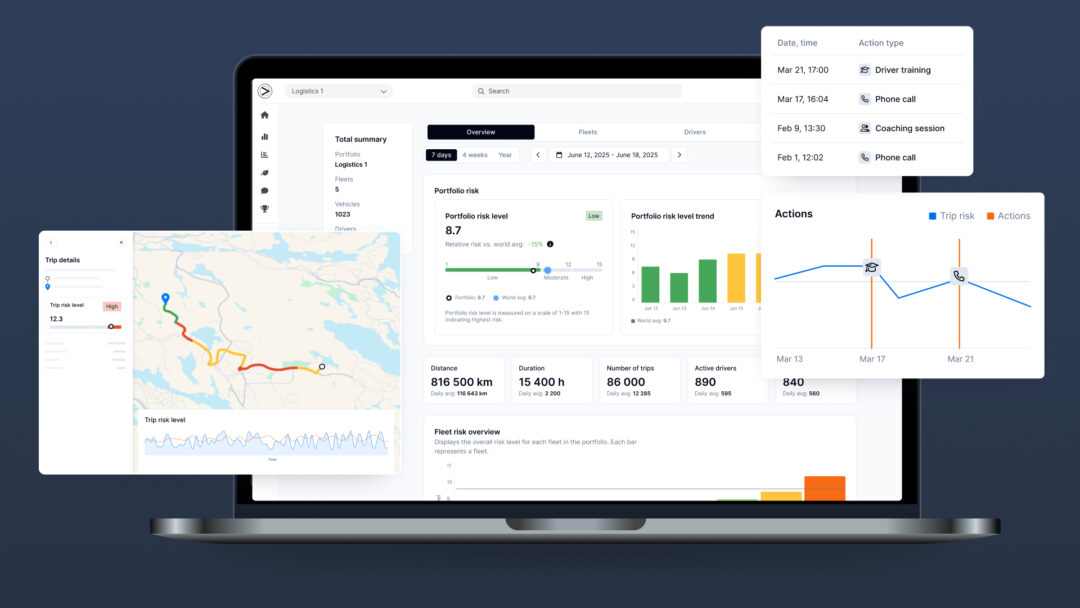
By ranking drivers based on behavioral patterns and exposure, a crash probability approach identifies where risk is statistically concentrated within a population. This makes it possible to prioritize attention, interventions, and resources; focusing on the few drivers who are most likely to represent a disproportionate share of future crashes, while avoiding unnecessary action for the many who are not.
Because this approach is relative rather than absolute, it also enables meaningful comparison across drivers, fleets, regions, and operating contexts.
Crash probability modeling extends risk management beyond reacting to incidents. It allows risk to be monitored continuously, training efforts to be targeted more precisely, and safety resources to be allocated where they are likely to have the greatest effect.
Instead of treating driving risk as a series of isolated events, organizations can understand it as an evolving pattern; one that can be measured, compared, and managed over time.